
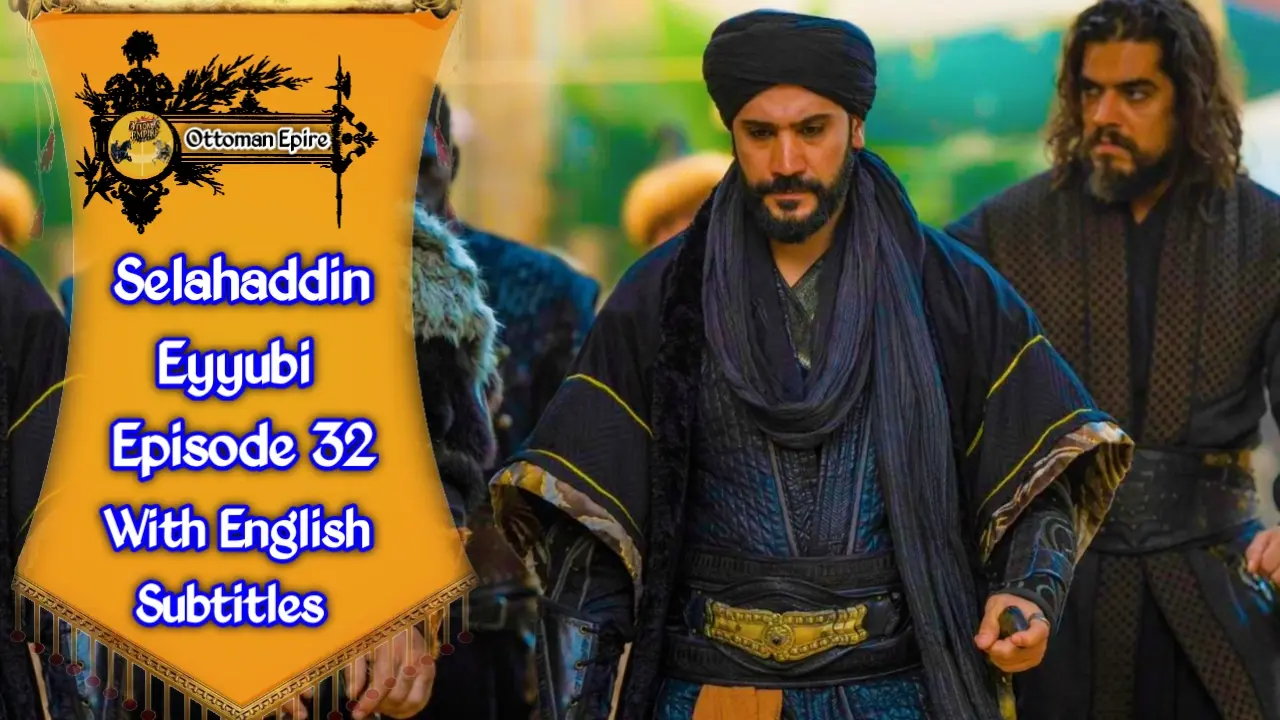
Salahuddin Eyyubi Chapter 32 power crisis & cairo’s rising tension
Introduction: After Bakras, the Situation Begins to Shift
After the events at Bakras, the situation does not settle—it begins to shift. What follows is not clarity, but a growing sense of pressure spreading across multiple centers of power. Decisions that once appeared controlled now start producing consequences that are harder to contain.
This chapter unfolds in a phase where authority is tested, alliances become uncertain, and stability begins to weaken across regions like Cairo and Jerusalem. Rather than open confrontation, the focus turns toward reaction, uncertainty, and the weight of unfolding outcomes.
After Bakras: When Outcomes Create New Challenges
The developments around Bakras do not bring closure. Instead, they open a new phase where expectations and results no longer align. Orders were clear, strategies were defined, and trusted commanders were deployed—yet the outcome introduces complications rather than resolution.
For Sultan Nur ad-Din, this is not just a military concern. It directly affects authority. In a system where leadership depends on discipline and perception, even a small disruption can lead to broader uncertainty.
This situation makes one thing clear: in medieval power structures, success must remain consistent. Any deviation, if left unaddressed, can influence confidence within allies and create opportunities for rivals.
The Sultan’s Response: Authority Through Discipline
Nur ad-Din’s reaction is immediate and firm. It is not simply emotional—it is strategic. Maintaining authority requires visible control, especially in a fragmented political environment where multiple factions operate independently.
Instead of isolating the issue, he responds in a way that reinforces discipline across the entire structure. Accountability becomes essential—not only to correct the present situation but to prevent instability from spreading further.
Strategic Impact of the Response
| Factor | Outcome |
|---|---|
| Authority | Reasserted through decisive action |
| Military Structure | Strengthened through enforced discipline |
| Internal Relations | Increased pressure among commanders |
This moment reflects a broader leadership pattern of the era, where order was often preserved through firm action rather than negotiation.
Jerusalem’s Internal Strain: Giyom Under Pressure
At the same time, a parallel situation develops within Jerusalem. Giyom’s independent movement toward Bakras places him in a vulnerable position within the Crusader leadership structure.
In uncertain times, independent action can quickly be interpreted as disloyalty. His return does not resolve the situation—instead, it leads to accusations that shift his position from trusted figure to suspect.
The charge against him is not only political but symbolic. His punishment reinforces authority within the court, but it also exposes the fragile nature of trust among leaders.
Governance Under Pressure
- Authority is maintained through control rather than consensus
- Rivalries shape decisions behind the scenes
- Loyalty is judged based on perception, not just action
This pattern becomes visible across both sides, showing that internal instability is not limited to one region.
Balian’s Return: The Weight of Responsibility
Away from the centers of power, Balian’s return to Ibelin introduces a different kind of challenge. Having fulfilled what he believed was his duty, he prepares to move forward with his own path.
However, the reaction of the people changes everything. Their dependence on him reveals a deeper reality—leadership is not always a choice. In many cases, it is shaped by the expectations of others.
This creates a difficult balance. Leaving would mean stepping away from responsibility, while staying would require personal sacrifice. His situation reflects a broader theme where leadership is defined not by intention, but by circumstance.
Cairo’s Complexity: A Center of Unstable Power
As the narrative shifts to Cairo, the scale of instability becomes more evident. The city is no longer just a political center—it has become a convergence point where multiple interests collide.
Salahuddin’s arrival does not bring order. Instead, it places him within an environment where alliances are temporary and threats are often hidden beneath the surface.
Working alongside Qadi al-Fadil, he begins to move carefully through this landscape. Direct action is no longer enough. The situation requires awareness, patience, and calculated decision-making.
Cairo’s Strategic Challenges
| Element | Description | Impact Level |
|---|---|---|
| Political Rivalries | Competing groups seeking influence | High |
| Hidden Opposition | Unclear sources of threat | Severe |
| Rapid Change | Shifting alliances and priorities | Critical |
This phase marks a clear shift in Salahuddin’s approach—from direct engagement to strategic positioning.
Power Shift Indicator
| Region | Situation Before | Situation Now |
|---|---|---|
| Zengid Side | Controlled authority | Internal pressure rising |
| Jerusalem | Structured governance | Increasing suspicion |
| Cairo | Political tension | Active instability |
This comparison shows how quickly the balance of power begins to change across regions, connecting separate developments into one larger pattern.
Şemse’s Path: A Journey Into a Larger Narrative
Şemse’s movement toward Jerusalem introduces a personal dimension, but its implications extend beyond individual purpose. Her journey reflects a transition from isolation into involvement within a larger chain of events.
Jerusalem, at this stage, is not just a destination. It represents a central point where political, cultural, and strategic interests intersect. Her role begins to align with these broader developments, suggesting that individual paths often become part of wider historical processes.
A Hidden Strategy: Pressure on the Zengid Structure
As events continue, it becomes increasingly clear that a broader strategy is forming—one that targets the Zengid structure indirectly rather than through open confrontation.
This approach operates through:
- Creating divisions within leadership
- Spreading uncertainty across alliances
- Applying pressure on key figures and positions
Conflict, in this phase, shifts from visible action to controlled influence. Success depends not only on strength, but on timing, awareness, and strategic planning.
For Salahuddin, this introduces a new kind of challenge—one that requires anticipation rather than reaction.
Leadership Insight: From Control to Adaptation
One of the defining aspects of this chapter is the contrast in leadership approaches.
- Nur ad-Din focuses on maintaining order through authority
- Salahuddin begins adapting to complexity and change
This difference highlights an important transition. Leadership is no longer just about control—it becomes about understanding evolving situations and responding accordingly.
Historical Context Note
It is important to recognize that such narratives often include dramatized elements. While the characters and events are based on historical frameworks, their interactions may be intensified for storytelling purposes.
In reality, the 12th-century Middle East was defined by political fragmentation, shifting alliances, and continuous external pressure. This article focuses on broader strategic and leadership dynamics rather than exact historical reconstruction.
Key Takeaways
- The aftermath of Bakras introduces instability rather than resolution
- Nur ad-Din reinforces authority through discipline
- Internal tensions affect multiple power centers
- Cairo emerges as a critical hub of political complexity
- Salahuddin begins shifting toward strategic leadership
- Indirect methods of conflict become increasingly important
Conclusion
Chapter 32 marks a shift from action to consequence. The focus is no longer on what was done, but on what those actions have created. Stability begins to weaken, and the structures that once appeared controlled start to show signs of strain.
For Salahuddin, this phase becomes a moment of transformation. It pushes him to move beyond direct confrontation and begin understanding how power truly operates—through influence, timing, and perception.
This chapter does not resolve conflict—it deepens it, setting the stage for a more complex and interconnected struggle ahead.
Frequently Asked Questions (FAQ)
Why is the aftermath of Bakras important?
It introduces instability and creates new challenges beyond the original campaign.
How does Nur ad-Din respond?
He reinforces discipline and authority to maintain control.
What happens to Giyom?
He faces accusations that weaken his standing in Jerusalem.
Why is Cairo central to this chapter?
It becomes a key center of political tension and shifting alliances.
What is Salahuddin’s main challenge now?
Managing hidden threats while adapting to a more complex environment.