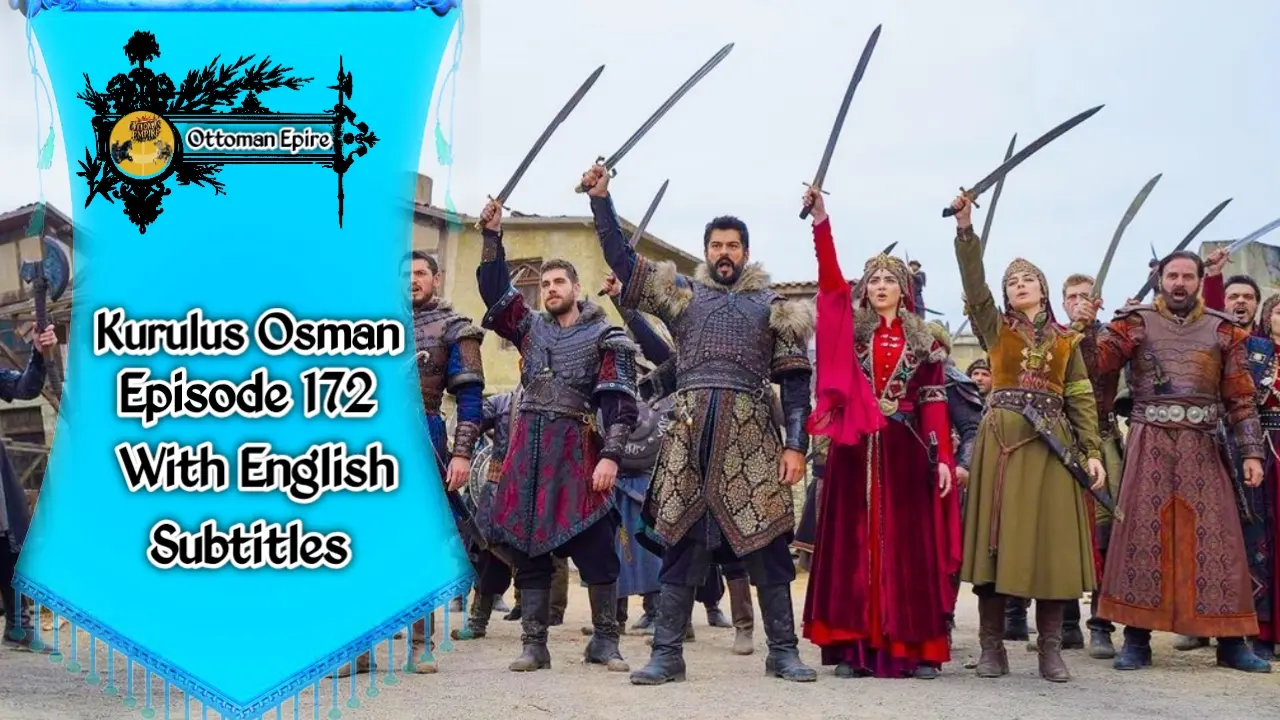
Kurulus Osman Chapter 172: Internal Developments and Leadership Challenges
A Phase Where Stability Becomes More Important Than Expansion
As frontier Anatolia continued to evolve under constant political pressure, the nature of leadership challenges also began to change. For Osman Bey, this phase was not defined by new conquests, but by the growing difficulty of protecting what had already been established. External threats remained present, but the real danger now came from calculated disruption and internal imbalance.
The environment surrounding the Kayı tribe had become increasingly fragile. Rival powers, particularly Byzantine-aligned figures and regional beys, were no longer relying only on open confrontation. Instead, they began using indirect strategies aimed at weakening cohesion. Within this shifting landscape, Sofia emerged as a key adversary whose approach relied less on force and more on controlled instability.
A particularly critical moment developed around Bala Hatun. Her role within the tribe extended far beyond her personal position. She functioned as a stabilizing force, maintaining internal balance while external campaigns continued. Any threat directed toward her had immediate implications for the entire structure of leadership. Whether the danger she faced was fully real or partially constructed as a psychological tactic, its impact was significant enough to disrupt confidence within the tribe.
Table of contents
- A Phase Where Stability Becomes More Important Than Expansion
- A Strategy Built on Fear, Not Force
- The Incident Involving Kayı Women and Its Wider Meaning
- Growing Suspicion Within the Inner Circle
- The Discovery That Complicates Internal Dynamics
- Lucas’s Countermove and the Exposure of Ilbay
- Managing Multiple Pressures Simultaneously
- Key Takeaways
- Conclusion
- Frequently Asked Questions (FAQ)
A Strategy Built on Fear, Not Force
Sofia’s approach demonstrates a deeper shift in how conflicts were managed in frontier regions. Instead of direct confrontation, her actions were designed to create pressure points. By targeting individuals of emotional importance and introducing uncertainty into daily life, she created a situation where reactions could become unpredictable.
This type of strategy is consistent with patterns observed in fragmented political environments. When authority is built on loyalty and shared identity, destabilizing those elements can produce far greater results than battlefield victories. Sofia’s objective was not simply to challenge Osman Bey militarily, but to force him into situations where every decision carried risk.
The emphasis on psychological pressure indicates an understanding that leadership is as much about perception as it is about control. If confidence weakens, authority follows.
The Incident Involving Kayı Women and Its Wider Meaning
One of the most sensitive developments in this phase was the deliberate targeting of women within the Kayı tribe. In the cultural framework of the time, women were central to maintaining continuity, order, and social structure. Their role extended into preserving traditions and ensuring stability during uncertain periods.
By creating a situation in which they were placed at risk, Sofia effectively targeted the core of the community. This was not merely an isolated incident but a calculated move intended to create widespread concern. When the sense of safety within a society is shaken, its ability to function normally is immediately affected.
At the same time, this situation intersected with existing tensions between Gonca Hatun and Holofira. Their relationship, already strained, now faced external pressure that required cooperation. Such moments often determine whether internal divisions deepen or begin to resolve. In this case, the outcome held importance not only for individual relationships but for overall unity.
Growing Suspicion Within the Inner Circle
As events unfolded, the atmosphere inside the Kayı tribe became increasingly tense. Trusted figures such as Boran and Cerkutay began to react strongly to the سلسلة of disruptions. Their concern gradually shifted into suspicion, particularly toward Begüm Hatun and Yusuf.
This reaction reflects a broader pattern seen in historical crises. When multiple challenges arise at once, internal trust can weaken. People begin searching for explanations, often focusing on those closest to the situation. While this can sometimes lead to identifying real threats, it can also create unnecessary division.
The tension became more visible during collective discussions, where differing views and underlying doubts surfaced openly. These moments highlight how internal stability can be affected not only by external actions but by how those actions are interpreted within the group. Kurulus Osman Chapter 172: Internal Developments and Leadership Challenges
The Discovery That Complicates Internal Dynamics
An additional layer of complexity emerged through the revelation concerning Begüm Hatun. Her personal feelings toward Osman Bey introduced a sensitive element into an already unstable environment. While such matters might seem private, in leadership contexts they often influence relationships, trust, and perception.
For Gonca Hatun, this information created a difficult decision. Revealing it could intensify existing tensions, while concealing it could allow underlying issues to persist. Situations like this demonstrate how personal factors can intersect with political realities, particularly in closely connected communities.
Historical examples frequently show that internal dynamics are not shaped solely by strategy or power, but also by human relationships and emotional responses.
Lucas’s Countermove and the Exposure of Ilbay
On the opposing side, developments took a decisive turn when Lucas began investigating the possibility of internal betrayal. Recognizing inconsistencies in outcomes, he chose a method based on observation rather than direct confrontation. By controlling information and monitoring reactions, he gradually identified the source of disruption.
This process led to the exposure of Ilbay. The presence of a traitor within a structured system represents one of the most serious risks to stability. In frontier environments, where alliances are often fragile, loyalty becomes a critical factor in maintaining control.
Ilbay’s removal reinforced the consequences of betrayal. While deception can provide short-term advantage, it carries long-term risk, particularly when discovered.
Managing Multiple Pressures Simultaneously
At this stage, the primary challenge for Osman Bey was not a single conflict but the accumulation of several interconnected issues. External threats, internal suspicion, emotional pressure, and strategic uncertainty all required attention at the same time.
Leadership in such conditions demands balance. Overreaction to one issue can weaken the response to another. The ability to maintain perspective while addressing immediate concerns becomes essential. This phase reflects a shift in leadership priorities—from expansion to preservation and consolidation.
Maintaining trust within the tribe became as important as countering external threats. Without internal cohesion, even the strongest external strategies would lose effectiveness.
Key Takeaways
- Conflict during this phase relied heavily on psychological and social pressure.
- Bala Hatun’s role highlights the importance of internal stability.
- Targeting community structure can be more impactful than direct confrontation.
- Suspicion within leadership circles can weaken unity if not managed carefully.
- Personal relationships can influence broader political dynamics.
- The exposure of betrayal reinforces the role of trust in maintaining power.
Conclusion
This phase of Osman Bey’s journey illustrates how leadership challenges evolve over time. What begins as a struggle for expansion eventually becomes a test of endurance and internal strength. The ability to manage complex situations, where emotional and strategic elements overlap, defines long-term success.
Sofia’s actions demonstrate that effective opposition does not always rely on direct conflict. By targeting the underlying structure of leadership, she created a situation where stability itself became uncertain. At the same time, internal tensions within the Kayı tribe revealed how quickly unity can be tested under pressure.
The outcome of such periods is rarely determined by a single event. Instead, it depends on how well leadership can maintain balance, preserve trust, and respond without losing direction. In this sense, the true challenge was not overcoming an external enemy, but ensuring that the foundation of the tribe remained intact.
Frequently Asked Questions (FAQ)
What makes this phase different from earlier conflicts?
The focus shifts from open confrontation to psychological pressure and internal challenges.
Why was Bala Hatun a key target?
Because she represented stability and unity within the Kayı tribe.
What was the purpose of targeting Kayı women?
To create fear and disrupt the social structure of the community.
Who was responsible for internal betrayal?
Ilbay was identified as the source of internal disruption.
How did internal suspicion affect leadership?
It created tension and risked weakening unity during a critical period.