How Orhan Bey Built the Early Ottoman State
The Transformation from a Frontier Beylik to a Structured State
When Orhan Bey assumed leadership after the death of his father, Osman Bey, the Ottoman polity was still a fragile frontier principality rather than a fully developed state. It had grown through courage, raids, and opportunistic expansion, but it lacked the institutional structure needed to sustain long-term power. Orhan inherited not just land, but a responsibility—to transform a loosely organized tribal entity into something more permanent and stable. This transition required a different kind of leadership, one that focused not only on expansion but also on governance, discipline, and continuity. In many ways, Orhan Bey’s challenge was greater than that of his father, because building a system is often more difficult than winning battles.
At the time, Anatolia was politically fragmented, with various Turkish beyliks competing for power while the Byzantine Empire struggled to maintain control over its remaining territories. This environment created both opportunities and risks. Orhan Bey understood that survival in such a landscape required more than military strength—it demanded organization, planning, and the ability to manage diverse populations. Instead of relying solely on the traditional methods of frontier warfare, he began shaping a structure that would support long-term growth. This marked the beginning of a new phase in Ottoman history, where strategy extended beyond the battlefield and into the foundations of statehood.
Bursa: The Birthplace of Ottoman Administration
From Conquest to Capital
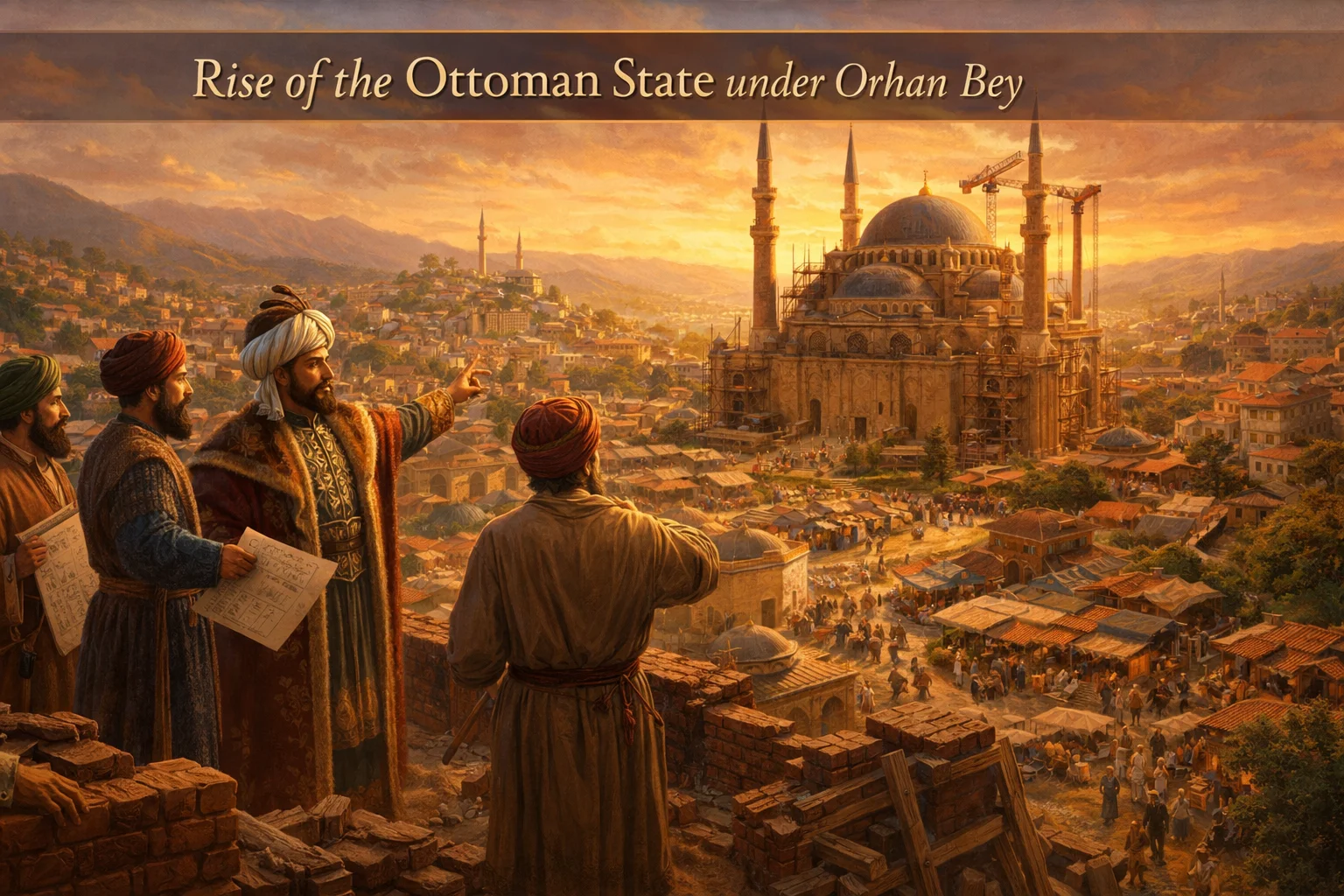
The capture of Bursa in 1326 was a turning point that went far beyond military success. For Orhan Bey, the city represented an opportunity to establish a fixed center of authority, something the Ottomans had not previously possessed. Unlike the earlier nomadic or semi-nomadic lifestyle of frontier warriors, a capital demanded stability, administration, and planning. By choosing Bursa as the center of his rule, Orhan signaled a clear shift in direction—from a mobile warband to an organized political entity.
Bursa quickly became more than just a symbol of victory; it evolved into the administrative heart of the early Ottoman state. Government functions began to take shape, and systems of taxation, law, and urban management were gradually introduced. Markets were regulated, trade routes were secured, and public institutions were established to support the growing population. This transformation showed that Orhan Bey understood a crucial principle of leadership: a strong state is built not only through conquest, but through the ability to govern what has been conquered.
Economic Growth and Urban Stability
As Bursa developed, it attracted merchants, craftsmen, and scholars from across the region. Its location made it a natural hub for trade, connecting different parts of Anatolia and beyond. Orhan encouraged this growth by ensuring security and stability, which in turn boosted economic activity. Over time, Bursa became a vibrant city where commerce flourished and cultural life expanded.
This economic strength played a vital role in supporting the Ottoman state. A stable economy meant a reliable source of revenue, which could be used to maintain the الجيش, fund public works, and strengthen administrative structures. Rather than focusing solely on expansion, Orhan invested in sustainability, ensuring that the state could endure beyond immediate victories. This balanced approach between growth and stability became a defining feature of his rule.
Administrative Reforms and the Rise of Governance
One of Orhan Bey’s most important achievements was the gradual development of administrative institutions that could manage a growing state. In the early days of Ottoman expansion, leadership relied heavily on tribal customs and personal loyalty. While effective in a small community, this system was not sufficient for governing a diverse and expanding population. Orhan recognized this limitation and began introducing more structured forms of governance.
He appointed officials to oversee taxation, law enforcement, and land distribution, creating a system that allowed for more consistent administration across different regions. These roles were not arbitrary but carefully designed to ensure efficiency and accountability. Over time, these early structures laid the foundation for a more complex bureaucratic system that would evolve in later centuries. It was through these quiet but significant reforms that the Ottoman state began to take shape as a functioning political entity rather than a loose collection of territories.
Military Organization: From Raids to Strategy
While Orhan Bey is often remembered for his administrative contributions, his approach to military organization was equally important in building the Ottoman state. Under Osman Bey, warfare had largely consisted of small-scale raids carried out by frontier warriors seeking both land and spoils. Orhan, however, began to shift toward a more organized and strategic model of warfare.
Instead of relying solely on irregular forces, he worked to create a more disciplined and coordinated army. Campaigns became more structured, with clear objectives and long-term planning. This shift allowed the Ottomans to expand more effectively while maintaining control over newly acquired territories. It also reduced the unpredictability associated with purely raid-based warfare.
At the same time, Orhan continued to expand into Byzantine territories, but his approach was more calculated than aggressive. He combined military pressure with diplomacy, often weakening his opponents before engaging in direct conflict. This method minimized losses while maximizing gains, demonstrating a level of strategic thinking that set him apart from many contemporary leaders.
Diplomacy and Alliances in a Fragmented Landscape
Orhan Bey’s success cannot be understood without considering his skill in diplomacy. Anatolia during this period was a complex network of alliances, rivalries, and shifting loyalties. Rather than viewing every neighboring power as an enemy, Orhan often chose cooperation when it served his interests. This approach allowed him to expand without overextending his resources.
In some cases, he formed alliances through marriage or negotiation, creating bonds that reduced the likelihood of conflict. These relationships were not merely symbolic; they played a practical role in maintaining stability and securing borders. By balancing force with diplomacy, Orhan ensured that the Ottoman state could grow steadily without facing constant resistance.
A ruler who understands when to fight and when to negotiate holds a significant advantage over those who rely on strength alone. This principle was clearly reflected in Orhan Bey’s leadership style, which emphasized patience, calculation, and long-term vision.
Religion, Society, and Integration
Another key aspect of Orhan Bey’s state-building efforts was his approach to religion and social integration. He supported the construction of mosques, schools, and charitable institutions, which served not only religious purposes but also social and cultural ones. These institutions helped create a sense of unity and identity among the population.
At the same time, the Ottomans maintained a relatively flexible approach toward non-Muslim communities. Rather than forcing strict uniformity, they allowed different groups to coexist under Ottoman rule, provided they accepted the authority of the state. This inclusiveness reduced resistance and encouraged cooperation, making it easier to govern newly conquered regions.
This balance between religious support and social pragmatism contributed to the stability of the early Ottoman state. It showed that Orhan Bey understood the importance of integrating diverse populations rather than relying solely on force to maintain control.
Economic Foundations of a Growing State
Economic stability was essential for sustaining the growth of the Ottoman state, and Orhan Bey took deliberate steps to strengthen it. By securing trade routes and ensuring safety for merchants, he encouraged commercial activity across his territories. Bursa, once again, played a central role in this process, becoming a key center for trade and production.
Agriculture was also supported, providing a stable food supply and contributing to overall economic health. Local industries, including textiles and craftsmanship, began to develop, further enhancing the region’s prosperity. These efforts created a balanced economy that could support both military and administrative needs.
Rather than focusing on short-term gains, Orhan invested in long-term sustainability. This approach ensured that the Ottoman state had the resources needed to continue expanding while maintaining internal stability.
Orhan Bey in Historical Narrative and Drama
In historical drama series, Orhan Bey is often portrayed as a figure who bridges two eras—the era of conquest and the era of state-building. While these portrayals sometimes emphasize personal struggles and dramatic moments, they also capture an essential truth about his leadership. Orhan was not just a warrior; he was a builder of systems, institutions, and lasting structures.
His legacy lies not in a single battle, but in the transformation he achieved. By turning a frontier principality into an organized state, he laid the groundwork for future Ottoman expansion. This narrative resonates with modern audiences because it reflects a universal idea: true leadership is measured not only by victories, but by what is built afterward.
Key Takeaways
- Orhan Bey transformed the Ottoman beylik into a structured state
- Bursa became the administrative and economic center
- Governance systems replaced tribal leadership models
- Military organization became more strategic and disciplined
- Diplomacy played a key role in expansion
- Economic and social policies ensured long-term stability
Conclusion
Orhan Bey’s reign represents a critical moment in the formation of the Ottoman state. While his father laid the foundation through conquest, Orhan provided the structure needed for long-term success. His ability to balance military strength with administrative development allowed the Ottomans to move beyond survival and toward stability.
By establishing a capital, introducing governance systems, and fostering economic growth, Orhan ensured that the Ottoman state would not only endure but continue to expand. His legacy demonstrates that the true strength of a state lies not only in its ability to conquer, but in its capacity to govern, adapt, and sustain itself over time.
FAQ
He introduced administrative systems, established Bursa as the capital, and strengthened the economy and military organization.
It served as the first administrative and economic center of the Ottoman state.
Osman focused on expansion, while Orhan focused on governance and state-building.
No, he used diplomacy, alliances, and economic strategies alongside military expansion.
Transforming a frontier principality into a structured and sustainable state.