
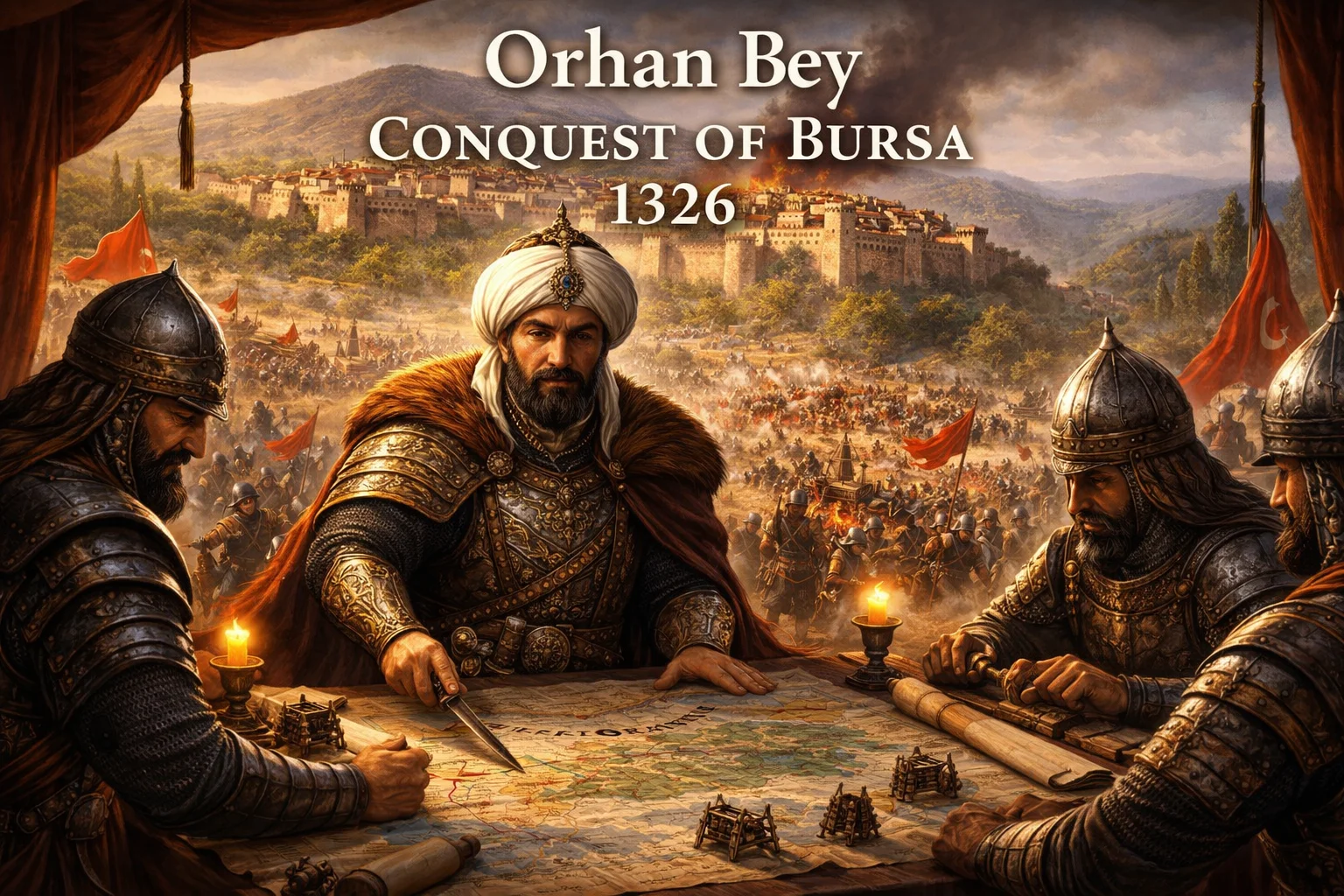
Orhan Bey and the Conquest of Bursa
The early rise of the Ottoman Empire is often remembered through dramatic battles, legendary leaders, and moments that changed the course of regional history. Among these defining moments, the conquest of Bursa occupies a central place. Long before the Ottomans became a vast empire stretching across continents, they were a small frontier principality struggling for survival and influence in the politically fragmented landscape of Anatolia. The capture of Bursa in 1326 marked the first time the Ottomans secured a major urban center and transformed their expanding frontier movement into a stable and organized state.
For Orhan Bey, the son of Osman Bey and the second ruler of the Ottoman dynasty, Bursa was more than just a military objective. The city represented security, legitimacy, and the opportunity to establish a permanent political center for a growing power. The conquest required patience, planning, and strategic leadership rather than a simple battlefield victory. Over time, the fall of Bursa would not only strengthen the Ottoman position in western Anatolia but also lay the foundations for a state that would eventually shape the history of Europe, the Middle East, and beyond.
The Political Situation of Anatolia Before the Conquest
To understand why Bursa became such an important objective for the Ottomans, it is necessary to look at the broader political environment of Anatolia during the early fourteenth century. At this time, the Byzantine Empire was no longer the dominant power it had once been. Internal conflicts, economic difficulties, and military pressure from various Turkish frontier groups had significantly weakened Byzantine authority across many regions of Asia Minor. Several cities remained under Byzantine control, but their ability to defend distant territories had steadily declined.
Meanwhile, numerous Turkish beyliks had emerged across Anatolia following the fragmentation of Seljuk authority. These small states were often engaged in both cooperation and rivalry as they competed for territory, resources, and influence. The Ottoman principality, founded by Osman Bey near the Byzantine frontier, initially appeared to be just one of many such political entities. However, its strategic location along the borderlands helped the Ottomans expand gradually through raids, alliances, and frontier warriors who actively sought opportunities for conquest and settlement.
Within this environment, Bursa stood out as one of the most prosperous and strategically valuable cities in the region. Located near important trade routes and surrounded by fertile lands, it served as a significant economic and administrative center. For a rising power like the Ottomans, controlling Bursa would mean gaining not only a fortified city but also access to the economic and political advantages that came with it.
Why Bursa Became a Key Target for the Ottomans
Bursa’s importance extended far beyond its impressive city walls. It was a center of commerce, craftsmanship, and agricultural productivity, making it one of the wealthiest cities in northwestern Anatolia. The city’s location at the foothills of Mount Uludağ also gave it a natural defensive advantage, making it difficult to capture through a simple direct assault.
For Orhan Bey and the Ottoman leadership, Bursa offered several strategic benefits. Controlling the city would strengthen their authority in the region, attract merchants and settlers to their territories, and provide a stable base for further expansion. Additionally, capturing such a prominent Byzantine stronghold would greatly enhance the reputation of the Ottoman state among both allies and rivals.
Yet the Ottomans understood that taking Bursa would not be easy. The city had strong fortifications and experienced defenders who were determined to protect it. Instead of rushing into a costly siege, the Ottoman leadership adopted a more gradual strategy designed to weaken the city’s ability to resist over time.
Sometimes the most important victories in history are achieved not through sudden attacks, but through patience and careful planning.
The Long Campaign Against Bursa
The campaign that eventually led to the conquest of Bursa unfolded over several years rather than through a single dramatic battle. Instead of launching an immediate large-scale siege, the Ottomans first focused on capturing smaller fortresses and settlements surrounding the city. By gradually extending their control across the countryside, they were able to cut off important supply routes and isolate Bursa from potential reinforcements.
This strategy proved highly effective. As Ottoman forces secured nearby towns and strategic positions, the defenders of Bursa found themselves increasingly surrounded. Trade routes that once supplied the city with food and resources became unreliable, and communication with other Byzantine territories grew more difficult. Over time, the pressure created by this slow encirclement began to weaken the city’s ability to maintain a prolonged defense.
Inside Bursa, the situation gradually became more challenging for the defenders. Supplies began to run low, and the hope of receiving assistance from the Byzantine Empire faded as the Ottomans tightened their control over the surrounding region. Although the city remained fortified, the strategic reality was becoming clear: the defenders could not hold out indefinitely against the growing Ottoman presence.
Eventually, after years of pressure and isolation, the city surrendered to the forces of Orhan Bey in 1326. This moment marked a decisive turning point in the history of the Ottoman state.
Orhan Bey’s Leadership During the Campaign
The conquest of Bursa revealed many of the leadership qualities that would later define Orhan Bey’s rule. Unlike some frontier leaders who relied solely on aggressive warfare, Orhan demonstrated a balanced approach that combined military capability with long-term strategic thinking. His willingness to adopt a patient strategy rather than risk unnecessary losses reflected a deep understanding of both warfare and governance.
Orhan Bey also recognized that the success of the Ottoman state depended not only on battlefield victories but also on the loyalty and organization of his followers. Frontier warriors, tribal allies, and newly settled communities all played a role in strengthening the Ottoman position in the region. By maintaining unity among these groups and coordinating their efforts over an extended campaign, Orhan ensured that the siege of Bursa remained sustainable.
A principle often associated with enduring leadership captures this idea well:
“Great leaders do not only win battles; they build the foundations that allow their people to prosper afterward.”
The conquest of Bursa demonstrated that Orhan Bey possessed the qualities necessary not just to conquer territory, but to transform those victories into lasting political achievements.
Bursa Becomes the First Ottoman Capital
After the city surrendered, the Ottomans faced an important decision about how to use their newly acquired stronghold. Rather than treating Bursa simply as a conquered city, Orhan Bey chose to transform it into the administrative and cultural center of the growing Ottoman state.
This decision had far-reaching consequences. Bursa soon became the first major capital of the Ottoman polity, serving as the place where political authority, economic activity, and cultural development could flourish together. Markets expanded, new communities settled within the city, and construction projects began to reshape its urban landscape.
The Ottoman administration established mosques, public baths, schools, and charitable institutions, reflecting their commitment to building stable and prosperous urban environments. They also encouraged merchants and craftsmen to settle in the city, helping Bursa grow into an important center of regional trade. Over time, the city became known not only for its strategic importance but also for its vibrant economic and cultural life.
The Historical Impact of the Conquest
The fall of Bursa represented a turning point that reshaped the future of the Ottoman state. Before this conquest, the Ottomans were primarily a frontier principality engaged in small-scale raids and territorial skirmishes. After Bursa became their capital, they began to develop the administrative institutions and economic structures necessary to support long-term expansion.
The conquest also strengthened the Ottomans’ reputation among neighboring powers. Controlling a major Byzantine city demonstrated that the Ottoman state was emerging as a serious political force in the region. This growing prestige helped attract new allies, settlers, and warriors who contributed to the state’s continued expansion.
Perhaps most importantly, the capture of Bursa established a model that the Ottomans would follow repeatedly in later centuries: gradual territorial expansion supported by strong administrative organization and economic development.
Major Events of the Bursa Conquest
| Event | Description |
|---|---|
| Strategic Objective | Bursa identified as a key Byzantine stronghold |
| Ottoman Expansion | Surrounding settlements gradually captured |
| Encirclement Strategy | City isolated by controlling nearby territory |
| Final Surrender | Bursa falls to Ottoman forces in 1326 |
| Capital Established | City becomes the first major Ottoman capital |
Key Takeaways
- Bursa was conquered by Orhan Bey in 1326 after a prolonged campaign.
- The conquest marked the first major urban victory for the Ottoman state.
- Bursa became the first capital of the early Ottoman polity.
- The campaign relied on strategic patience rather than a single battle.
- This victory helped transform the Ottomans from a frontier principality into a structured political power.
Conclusion
The conquest of Bursa stands as one of the most significant milestones in the early history of the Ottoman Empire. Under the leadership of Orhan Bey, the Ottomans achieved far more than a military victory. They secured a strategic city that allowed them to establish administrative institutions, develop economic networks, and expand their influence across Anatolia.
By transforming Bursa into their first capital, the Ottomans laid the foundations for a state that would continue growing for centuries. The city became a symbol of both conquest and governance, illustrating how careful leadership and strategic planning can shape the destiny of nations.
The story of Bursa reminds us that empires are not built through battles alone. Leaders build them through vision, patience, and the ability to transform victory into lasting stability.
FAQ
Bursa was conquered in 1326 during the leadership of Orhan Bey after a long campaign that gradually isolated the city from external support.
Bursa was a wealthy and strategically located city that provided economic resources, strong defenses, and an ideal location for a political capital.
Bursa was a wealthy and strategically located city that provided economic resources, strong defenses, and an ideal location for a political capital.
Yes, Bursa became the first major capital of the Ottoman state and remained an important political and cultural center for many years.
The conquest transformed the Ottoman principality into a more organized state and laid the foundations for future expansion across Anatolia and beyond.