
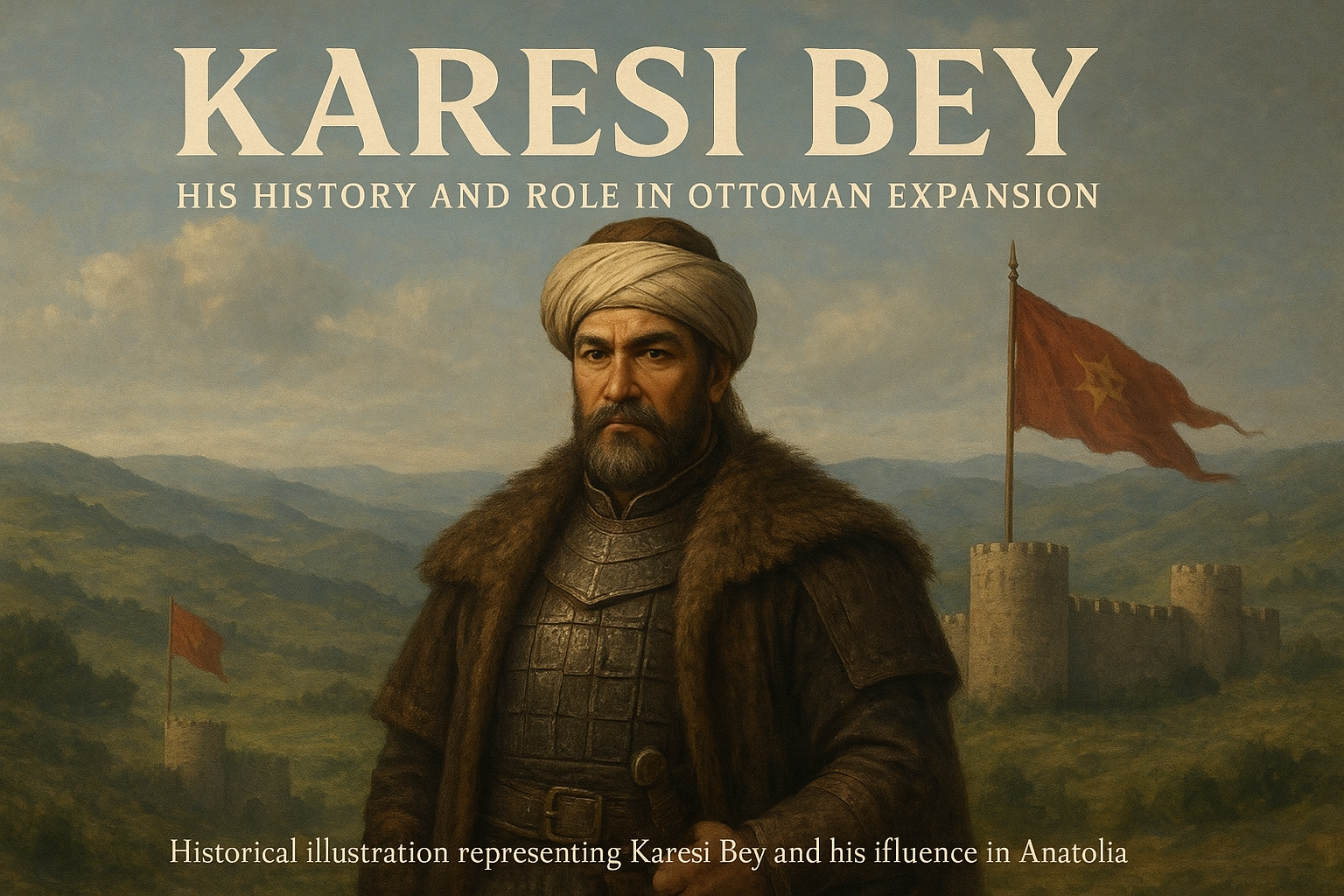
Karesi Bey His History and Role in Ottoman Expansion
Introduction: Restoring a Forgotten Chapter of Ottoman History
When the story of the Ottoman Empire is told, it often begins and ends with a few legendary names. Osman Ghazi, Orhan Bey, and later Murad I dominate popular narratives, while other crucial contributors slowly fade into the background. Among these overlooked figures stands Karesi Bey, a regional ruler whose political foresight and territorial control played a silent yet decisive role in shaping early Ottoman success.
Karesi Bey His History and Role in Ottoman Expansion
The rise of the Ottomans did not occur in a vacuum. It was the result of a complex political environment in Anatolia, where neighboring Turkish beyliks, weakened Byzantine territories, and shifting alliances created both danger and opportunity. The Karesi Beylik, founded by Karesi Bey in northwestern Anatolia, became one of the most strategically significant principalities of this era.
This article revisits the real history of Karesi Bey through a deep, paragraph-driven narrative. Rather than presenting fragmented facts, it reconstructs the political, military, cultural, and geographic importance of Karesi Bey and explains how his legacy directly influenced the expansion of the Ottoman state.
The Political Fragmentation of Anatolia After the Seljuks
The late 13th century was a period of political disintegration in Anatolia. The Seljuk Sultanate of Rum, once a dominant power, had been weakened by internal struggles and Mongol intervention. Central authority collapsed, leaving behind a patchwork of independent Turkish beyliks competing for territory, legitimacy, and survival.
In this fractured environment, power did not depend solely on military strength. Leadership required administrative skill, the ability to manage local populations, and the wisdom to navigate diplomacy alongside warfare. Beyliks that failed to establish stability disappeared quickly, while those that adapted endured.
Northwestern Anatolia, in particular, emerged as a contested frontier zone. Its proximity to Byzantine lands, fertile plains, and access to coastal routes made it a magnet for ambitious leaders. It was within this volatile setting that Karesi Bey rose to prominence.
The Origins and Identity of Karesi Bey
Historical records about Karesi Bey’s early life are limited, a common challenge when studying frontier rulers of this period. However, most historians agree that Karesi Bey was of Turkic origin and likely connected to military-administrative circles that emerged after the Seljuk decline.
What distinguished Karesi Bey from many contemporaries was his emphasis on governance alongside conquest. Rather than ruling purely through force, he focused on consolidating authority, organizing territory, and ensuring continuity. This approach allowed the Karesi Beylik to survive beyond the founder’s lifetime, a rare achievement among early Anatolian principalities.
Karesi Bey established his capital around the Balıkesir region, laying the foundation for a principality that would soon command both inland and coastal territories. His leadership reflected a pragmatic understanding of power—one rooted in sustainability rather than constant expansion.
Geography as Destiny: Why the Karesi Beylik Mattered
The true strength of the Karesi Beylik lay in its geography. The territory controlled by Karesi Bey stretched from fertile inland plains to the shores of the Aegean Sea, placing it at the crossroads of land and maritime routes.
This location offered multiple advantages. Inland regions supported agriculture and population growth, while coastal access enabled trade and naval activity. Control over areas near the Dardanelles further enhanced strategic value, as this corridor connected Anatolia to Europe.
For the Ottomans, who initially lacked maritime experience, the Karesi region later became a gateway to the Aegean and the Balkans. In this sense, geography transformed Karesi Beylik from a regional power into a historical bridge between Asia and Europe.
Military Organization and Early Naval Experience
Unlike many beyliks that focused exclusively on land warfare, the Karesi Beylik developed an early understanding of naval power. Historical sources indicate that Karesi forces engaged in maritime activities across the Aegean, including coastal defense and sea-based raids.
This naval experience was revolutionary for its time. It allowed the Karesi Beylik to protect trade routes, challenge Byzantine coastal strongholds, and project power beyond land borders. When the Ottomans later absorbed Karesi territory, they inherited not just land, but knowledge—experienced sailors, shipbuilders, and an understanding of maritime strategy.
This inheritance accelerated Ottoman naval development and helped transform them into a future Mediterranean power.
Governance, Law, and Cultural Stability
Karesi Bey’s rule was marked by a balanced approach to administration. Drawing from Seljuk traditions and Islamic governance principles, he established local authority structures that maintained order without excessive centralization.
Religious institutions played a vital role in social stability. Mosques, foundations, and scholars reinforced moral authority and integrated Islamic values into daily life. At the same time, Turkic customs continued to shape social organization, creating a hybrid cultural environment unique to Anatolia.
This administrative maturity ensured that when the Ottomans later took control, the region did not resist integration. Instead, it adapted smoothly, reflecting the strength of the systems Karesi Bey had put in place.
Decline of the Karesi Beylik and Ottoman Absorption
Following the death of Karesi Bey, internal rivalries weakened the principality. Leadership disputes fractured authority, leaving the beylik vulnerable to external influence. This decline was gradual rather than sudden, marked by political instability rather than military defeat.
Around 1345 CE, Orhan Bey of the Ottomans intervened. Instead of launching a destructive campaign, the Ottomans employed diplomacy combined with strategic pressure. The Karesi Beylik was absorbed into the Ottoman state with minimal bloodshed.
This event marked a turning point in Ottoman history. It demonstrated a new model of expansion—one based on absorption and integration rather than annihilation.
Strategic Gains for the Ottoman State
The incorporation of the Karesi Beylik dramatically reshaped Ottoman capabilities. The Ottomans gained access to the Aegean coast, opening new trade routes and military possibilities. They acquired experienced soldiers and commanders familiar with both land and naval warfare.
More importantly, the Ottomans inherited a strategic mindset. The Karesi legacy taught them the value of geography, maritime power, and administrative continuity. These lessons would later define Ottoman expansion into Europe.
| Area | Long-Term Impact on Ottomans |
|---|---|
| Geography | Direct access to the Aegean and straits |
| Military | Trained troops and commanders |
| Naval Power | Foundations of Ottoman fleet |
| Expansion | Gateway to Balkan campaigns |
Karesi Bey in Historical Memory
Despite his influence, Karesi Bey remains largely absent from popular historical narratives. This omission reflects a broader tendency to simplify empire-building around iconic founders while ignoring supporting figures.
Yet history reveals a more complex reality. Empires are built through accumulation—of land, experience, institutions, and ideas. Karesi Bey contributed all four, even if his name rarely appears in mainstream accounts.
From Karesi to Rumelia: A Historical Continuum
The territories once governed by Karesi Bey became launching points for Ottoman campaigns into Rumelia. The capture of Gallipoli and subsequent Balkan expansion were made possible by earlier geographic and naval foundations.
This continuity underscores the long-term impact of Karesi Bey’s rule. His principality did not disappear; it transformed into a cornerstone of Ottoman imperial strategy.
Key Takeaways
- Karesi Bey founded a strategically vital beylik in northwestern Anatolia
- His emphasis on governance ensured long-term stability
- The beylik developed early naval capabilities
- Ottoman absorption of Karesi territory was largely peaceful
- Karesi Bey’s legacy directly enabled Ottoman expansion
Frequently Asked Questions
Karesi Bey controlled a region that provided the Ottomans with maritime access, military experience, and strategic depth.
No. It was absorbed through diplomacy and political negotiation during Orhan Bey’s reign.
Yes. His beylik’s maritime experience laid the groundwork for early Ottoman naval development.
Conclusion: Reclaiming Karesi Bey’s Place in History
Karesi Bey was not a minor regional ruler, but a key architect of Ottoman success. His vision, administrative stability, and strategic territory prepared the ground upon which the Ottomans built an empire.
By restoring Karesi Bey to his rightful place in history, we gain a clearer, more accurate understanding of how the Ottoman Empire truly emerged—not through isolated heroism, but through cumulative strategy, geography, and governance.
History remembers conquerors, but it is shaped by those who prepare the path to conquest.